Range time can make a soldier accurate. CQB (Close Quarters Battle) drills inside a constructed shoot house can build the basic movement patterns. But both, no matter how well-built the facility, run into limits that are hard to push past. A live-fire range doesn’t introduce ethical decision pressure. The same shoot house run ten times loses the element of surprise. A scenario set up by an instructor, however well-designed, still feels set up.
This is the gap VR combat training closes. Not by replacing live training — that’s not a serious position to take — but by adding training dimensions that conventional methods can’t reach. The five elements below are realism components that other methods struggle to match, and they explain why elite units in various countries are starting to fold VR into their training cycles.
1. Scenario Variety Without Logistical Limits
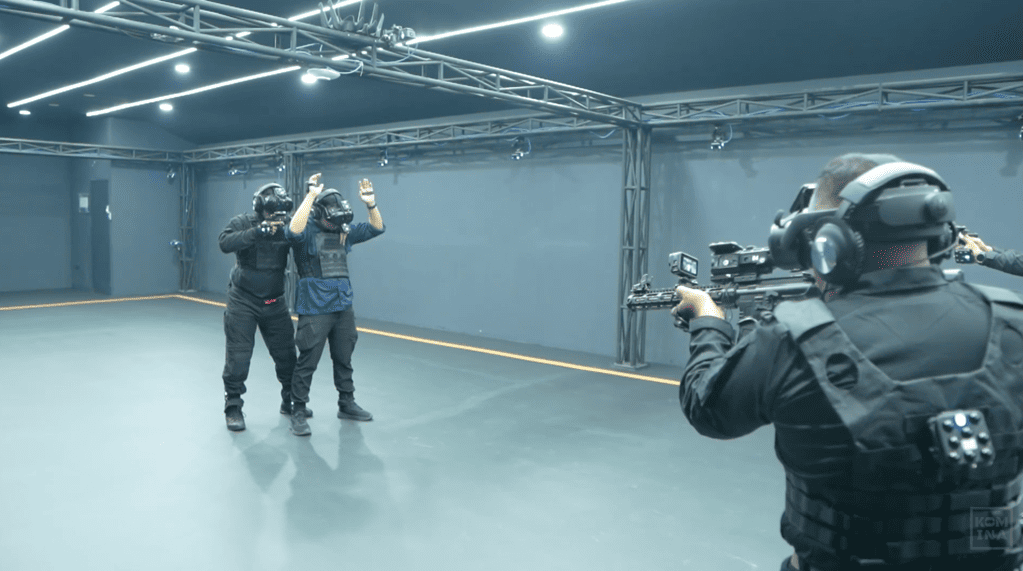
Building a single realistic shoot house for hostage rescue simulation requires major investment — construction, maintenance, and significant physical space. Once it’s built, that shoot house is one scenario. Reconfiguring it takes days of work and additional budget.
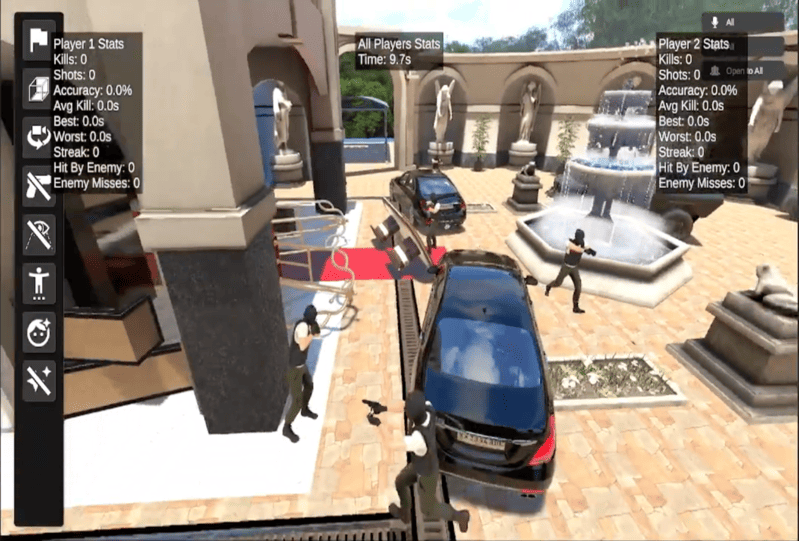
In VR combat training, the same scenario can be reconfigured in minutes. A hostage rescue at a hotel can immediately switch to a commercial aircraft operation, then to a government building, then to a residential home in a narrow alley. Each scenario presents a different layout, threat count, and complexity. An operator who has memorized the physical shoot house layout suddenly has to start thinking from scratch in a new virtual environment.
This kind of variety is what builds adaptability. The kind of capability that’s hard to train when the physical scenario is the same session after session.
2. Zero Risk for Lethal Scenarios
Some scenarios are too dangerous to train physically, even for the most experienced special units. Live ammunition drills in confined spaces. Explosives handling under time pressure. Operations involving complex multi-team coordination with crossing lines of fire.
Training accidents are a real and expensive cost — measured in lives and in unit recovery time. VR allows even the most dangerous scenarios to be trained without physical consequences. Operators can make mistakes that would be fatal in real conditions, see the outcome, and repeat until the right pattern forms. Hundreds of repetitions for complex scenarios become possible without putting anyone in danger.
3. Stress Inoculation Through Multi-Sensory Stimulus
The ability to act correctly under high stress doesn’t form from reading SOPs. It forms from repeated training under conditions that trigger the body’s stress response. This is the principle of stress inoculation that has long been used in professional military training.
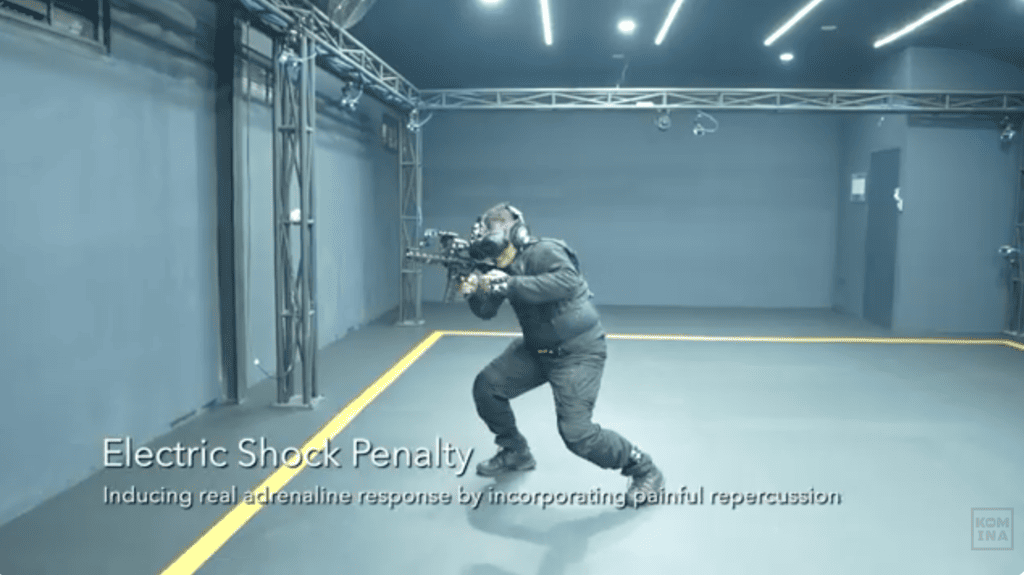
Modern VR combat training doesn’t rely on visuals alone. Haptic feedback systems like the shockbelt deliver a physical sensation when an operator takes a virtual hit. Spatial audio places weapon sounds, footsteps, and ambient noise at acoustically accurate positions. The combination triggers genuine physiological responses: heart rate climbs, focus narrows, adrenaline rises. These are training conditions that come close to operational reality.
In conventional training, stress inoculation is hard to distribute consistently across all participants. Some get pressure from a strict instructor, some don’t. In VR, stress factors can be set and held consistent across the entire unit.
4. After-Action Review Built on Objective Data
After physical training, evaluation typically depends on instructor observation. That’s valuable, but it has clear limits — an instructor can’t see everything that happens at once, and human perception carries its own biases.
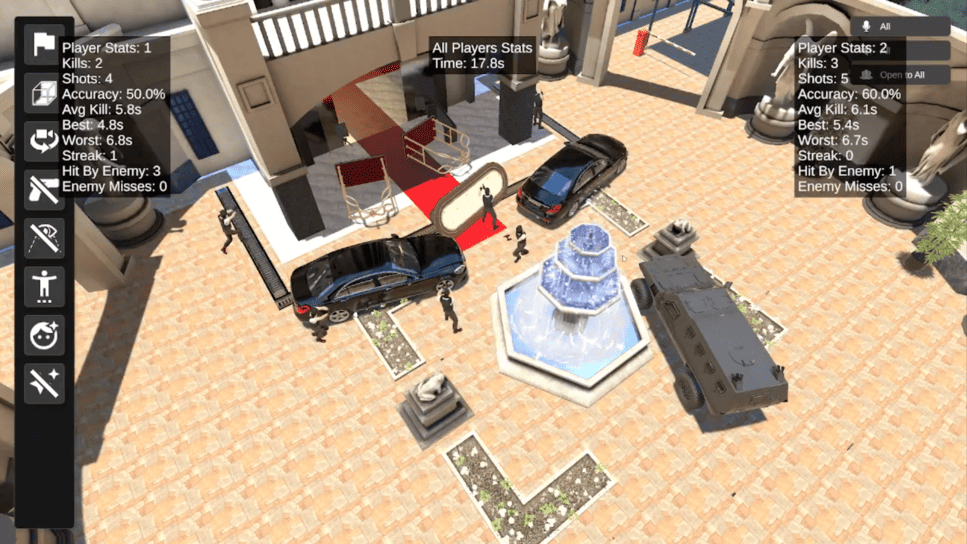
Every action in VR combat training is logged digitally. Each operator’s position every second. Firing angles. Movement paths. Reaction time to stimulus. Decisions made at critical moments. After the session ends, the team can review three-dimensional footage from any angle — including from the perspective of the virtual threat.
Data-based After-Action Review changes the dynamic of evaluation. It’s no longer “I felt you were too slow at the second door” — it’s “the data shows your reaction was 0.8 seconds slower than the team average, and your body position blocked your teammate’s line of sight”. Specific, objective lessons. Progress that can be measured between sessions.
5. Training for Coordinators and Decision-Makers, Not Just Operators
In conventional combat training, the focus is usually on the operator executing the action. Commanders and decision-makers who have to make strategic calls from the rear are less often trained under comparable pressure.
VR allows multi-level training within a single scenario. Operators run the tactical task. The squad leader decides formation and timing. The higher-level commander makes strategic calls based on incoming information. Each level is trained under the pressure and responsibility appropriate to its role.
Complex scenarios involving multiple teams, multiple locations, and multi-level decision-making are hard to set up in physical training. The logistics are punishing. In VR, a single system can accommodate the entire command structure in one synchronized session, with full documentation of how decisions at each level affected the operation’s outcome.
Where VR Sits in the Broader Training Cycle
Positioning VR combat training correctly matters. Live-fire training remains essential for building motor habits with weapons, managing recoil, and getting familiar with the weight and ergonomics of actual equipment. Live-fire ranges and physical shoot houses aren’t going away.
What VR does is fill in the cycle with components that other methods can’t reach. Many professional units overseas run the following model: physical training for fundamental skills, then VR for scenario variety, decision-making, and stress inoculation, then back to physical training for integration. This combination has consistently produced operators who are better prepared than those receiving only one type of training.
KOMINA develops a VR combat training platform built for the Indonesian context — scenarios that reflect local terrain, command structure, and threat profiles. This is a different approach from adopting foreign platforms whose scenarios and assumptions were designed for other contexts.
Closing
Realism in tactical training isn’t about how real the training looks from the outside. Real realism is how close the training conditions come to the pressure, complexity, and uncertainty of actual operational ground. The five elements above are realism components that physical training alone struggles to deliver — not because physical training doesn’t matter, but because of the structural limits of conventional methods.
VR combat training won’t replace traditional combat training any time soon — and shouldn’t. But for certain crucial components, it offers capability that simply wasn’t available before. For units serious about preparing operators for modern operational reality, this consideration has moved from “interesting” to “worth thinking about this year”.