


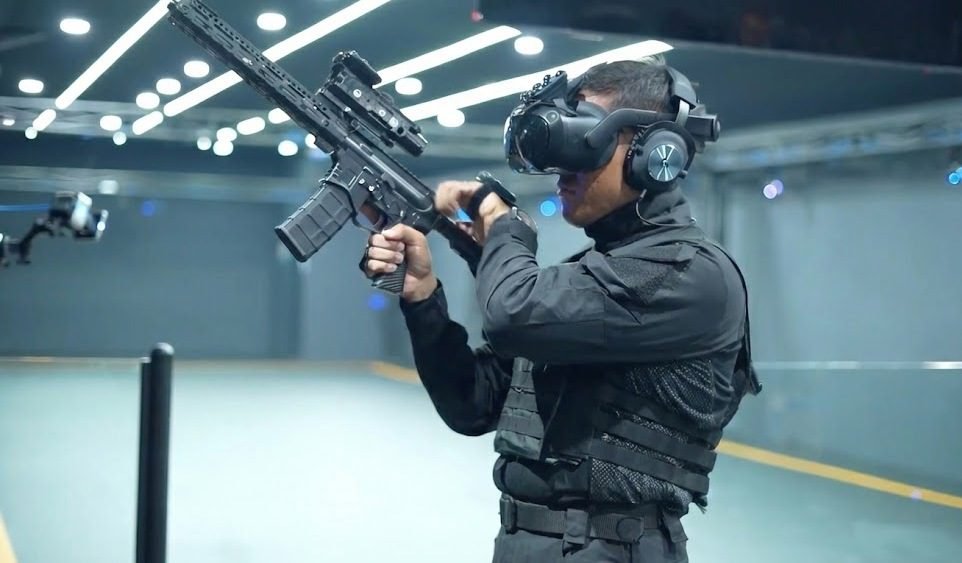
Somewhere in the Indonesian archipelago, a Kopassus operator is clearing a building room by room. His rifle is up, finger indexed on the trigger guard. Smoke fills the corridor. Hostages are screaming. A door bursts open—and in that fraction of a second, he must decide: threat or civilian?
He pulls the trigger. Center mass. Threat neutralized.
Then he removes his VR headset, and the instructor pulls up the replay on a screen nearby.
This is not science fiction. This is happening right now. And it represents one of the most significant shifts in how Indonesia’s most elite fighting force prepares for war.
A Legacy Written in Mud and Blood
For decades, the mystique surrounding Kopassus—the Special Forces Command of the Indonesian National Armed Forces—has been forged in some of the most unforgiving terrain on Earth. The jungles of Kalimantan. The mountains of Papua. The swamps of Sumatra.
Their training is legendary, bordering on mythical. Stories circulate about selection courses where candidates survive on snakes and rainwater for weeks. Where sleep is a luxury and pain is the curriculum. The Red Beret isn’t given—it’s earned through suffering.
“Berani, Benar, Berhasil”—Daring, Right, Successful. That motto has guided generations of operators through some of Indonesia’s most sensitive operations. From counter-terrorism to hostage rescue, Kopassus has built a reputation as one of Southeast Asia’s premier special operations units.
But here’s the uncomfortable truth that military planners have had to confront: the battlefield is changing faster than traditional training can keep up.
The Enemy Doesn’t Fight Like It Used To
The threats facing Indonesia in 2026 look nothing like they did even a decade ago. Today’s adversaries don’t wait in jungle clearings. They hide in apartment complexes. They blend into crowds at shopping malls. They strike fast, create chaos, and disappear before conventional forces can respond.
Asymmetric warfare. Urban combat. Hybrid threats. These aren’t just buzzwords—they’re the operational reality that special forces must now contend with daily.
Physical endurance? Still absolutely critical. You can’t operate on zero sleep in hostile territory without an iron body. But here’s what decades of counter-terrorism operations have revealed: in the critical moments of a hostage rescue or a terrorist takedown, it’s often cognitive speed that determines who lives and who dies. Not just strength. Not just stamina. The ability to process information, make split-second decisions, and execute flawlessly under overwhelming pressure.
How do you train for that? You can’t exactly stage real terrorist attacks for practice.
Enter KOMINA: The Force Multiplier
This is where Komando Imersif Indonesia—better known as KOMINA—enters the picture.
Let’s address the skepticism head-on. When you first hear that elite jungle warriors are strapping on VR headsets, the reaction is often a raised eyebrow. Video games? For Kopassus? It sounds almost absurd.
But spend five minutes talking to the defense planners who made this decision, and the logic becomes crystal clear.
Running live-fire exercises for high-stakes scenarios is brutally expensive. Every door breach costs money. Every round fired costs money. Every hour at the shooting range costs money. And beyond the budget, there are physical limits. You can only blow so many walls and fire so many live rounds before either the training facility is destroyed or someone gets hurt.
KOMINA’s VR military training platform doesn’t replace the mud, sweat, and live-fire drills that have always defined Kopassus training. It amplifies them. It allows operators to rehearse complex scenarios hundreds of times before they ever execute them for real. It turns expensive, dangerous, logistically-nightmarish training evolutions into repeatable, data-driven learning experiences.
Stress Inoculation: Training the Mind to Stay Calm in Chaos
Here’s something that might surprise you: shooting accurately isn’t the hardest part of close-quarters combat.
Any reasonably trained soldier can put rounds on target at a static range. Give them a clear line of sight, a stationary target, and time to aim—and accuracy is almost guaranteed.
Now change the variables. Add smoke. Add noise—deafening gunfire, explosions, screaming. Add movement—targets that appear and disappear in milliseconds. Add moral complexity—hostages mixed with hostiles, civilians who might be threats, threats who might be civilians.
Under those conditions, the human brain does something incredibly unhelpful: it panics. Blood rushes away from the prefrontal cortex (the decision-making center) and floods the amygdala (the fear center). Fine motor skills degrade. Tunnel vision sets in. Officers have been known to empty entire magazines at close range and miss every shot—not because they can’t shoot, but because their brain has essentially short-circuited.
The military calls overcoming this “stress inoculation.” The idea is simple: expose operators to the sensory chaos of combat so many times that their nervous system stops treating it as a crisis. By the time they face a real threat, the panic response has been drilled out. They’ve been, in essence, vaccinated against fear.
KOMINA’s VR platform creates this chaos on demand. Hostage scenarios with unpredictable outcomes. Ambushes that come from unexpected directions. Environments designed to overwhelm the senses. Operators can experience the “fog of war” over and over again—without the body count that would result from learning these lessons the hard way.
The Digital Twin: Know the Battlefield Before You Step Into It
In special operations, there’s an old saying: intelligence is ammunition.
If you know the terrain—every doorway, every stairwell, every potential ambush point—you own the fight before it even begins. The problem is, in hostage rescue or counter-terrorism operations, you often don’t have the luxury of scouting the location beforehand. You get a set of blueprints if you’re lucky. Maybe some satellite imagery. And then you’re expected to breach, clear, and extract with minimal casualties.
KOMINA’s Digital Twin technology changes this equation entirely.
Using available intelligence—architectural plans, photographs, drone footage, whatever can be gathered—KOMINA builds a 1:1 virtual replica of the target location. Not a rough approximation. An exact copy, down to the furniture placement and lighting conditions.
Before a Sat-81 (Kopassus counter-terrorism unit) assault team ever sets foot in the actual building, they can walk through it virtually. Dozens of times. Hundreds of times. They memorize the floor plan until it’s burned into muscle memory. They identify blind corners, fatal funnels, and optimal breach points. They test different entry strategies and see which ones work best.
When the actual operation happens, the operators aren’t reacting to an unfamiliar environment. They already know it inside and out. They’ve been there before—virtually. And that familiarity can mean the difference between a clean extraction and a tragedy.
Data Doesn’t Lie: The End of Subjective Assessment
Picture a traditional training debrief. An instructor gathers the team, reviews what happened, and offers feedback based on what he observed. “I think you were slow on that door entry.” “Your muzzle discipline was a bit sloppy.” “You hesitated on that last target.”
These assessments aren’t wrong, necessarily. Experienced instructors have trained eyes that catch details others miss. But they’re also inherently subjective. Memory is imperfect. Perspective is limited. Two instructors watching the same drill might come away with different conclusions.
KOMINA’s VR system eliminates this ambiguity by recording everything and converting it into hard data.
Reaction Time: Not “you were slow”—but “you engaged the target 340 milliseconds after visual acquisition, which is 90 milliseconds slower than your average.”
Shot Placement: Not “your aim was off”—but “your first round impacted 4 centimeters low and left of center mass at 7 meters.”
Eye Tracking: Not “you weren’t scanning properly”—but “you spent 73% of the engagement focused on the primary threat and only 12% checking your flanks.”
Decision Accuracy: Not “you shot the wrong person”—but a clear, timestamped record of every shoot/don’t-shoot decision with outcome analysis.
This After Action Review (AAR) data gives commanders an objective, unvarnished assessment of unit readiness. No more arguments. No more guesswork. Just facts—and the ability to fix problems with surgical precision.
Complement, Not Replacement: The Hybrid Training Model
Let’s be absolutely clear about something: KOMINA’s VR training is not meant to replace traditional Kopassus training methods. That would be absurd. You cannot simulate the physical exhaustion of a 30-kilometer ruck march. You cannot replicate the mental strain of surviving in the jungle for weeks with minimal supplies. You cannot virtualize the bond that forms between soldiers who have suffered together.
What VR does is fill the gaps that traditional training cannot address efficiently.
Need to rehearse a specific building assault 50 times before execution day? VR handles that without consuming resources.
Need to expose operators to scenarios that would be too dangerous to replicate physically—like chemical weapon attacks or aircraft hijackings? VR makes it possible.
Need to train decision-making under stress without the risk of training accidents? VR is the only viable option.
The result is a hybrid training model where physical conditioning, fieldcraft, and live-fire exercises remain the foundation—but VR simulation adds a layer of cognitive training and tactical rehearsal that was simply impossible before.
The Verdict: Tradition Meets Tomorrow
The adoption of KOMINA’s immersive technology by Kopassus sends a clear message: the Red Berets are not just warriors; they are adaptive learners. An organization willing to leverage every available tool to maintain its edge.
This isn’t about abandoning tradition. It’s about evolving it.
The legendary grit of the Kopassus commando—forged in decades of jungle warfare, counter-insurgency, and high-stakes operations—remains the core. But that core is now augmented by precision simulation technology that sharpens tactical skills, accelerates learning curves, and prepares operators for scenarios they’ve never physically encountered.
The threats facing Indonesia will continue to evolve. Adversaries will become more sophisticated. Battlefields will become more complex. The margin for error will shrink.
By fusing heritage with innovation, Kopassus is ensuring that when that door bursts open and the split-second decision must be made—they’ll be ready.
Ready to Modernize Your Unit’s Training Doctrine?
Whether you’re developing training programs for military special operations, law enforcement tactical units, or private security forces, KOMINA offers tailored defense simulation solutions designed for real-world operational requirements.
Contact Us
Ready to transform your mining operations with Digital Twin technology?
Discuss your system architecture and specific site requirements with our expert team.
Web: www.virtu.co.id
Call/WA: +62 812 9696 7887
Email:enquiry@virtu.co.id