


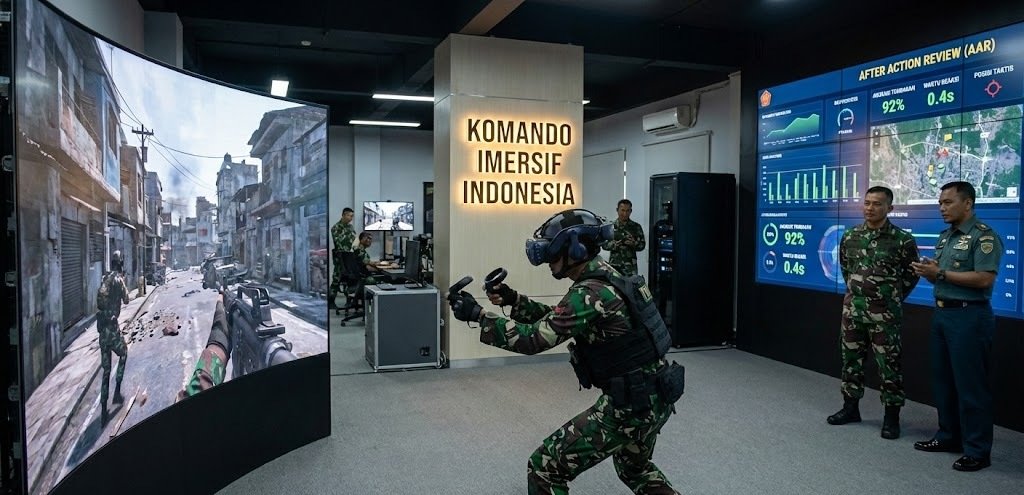
In the doctrine of modern warfare, the speed of adaptation is the currency of supremacy. Yet, conventional training methods frequently encounter a hard logistical ceiling: physical limitations. Live training is expensive, inherently hazardous, and notoriously difficult to scale.
This is where KOMINA shifts the paradigm. Far more than a visual aid, VR-based combat simulation training has been proven by data to increase learning effectiveness by up to three times compared to traditional classroom instruction.
Why is this shift occurring? It is not technological magic; it is cognitive science and operational efficiency. Here is an in-depth analysis of why elite defense units are choosing KOMINA to multiply their combat readiness.
1. Kinesthetic Learning: Beyond Theory (Retention Rate)
Studies from the National Training Laboratory reveal a brutal reality: Soldiers retain only about 5% of material from classroom lectures and 10% from reading manuals. The rest evaporates.
KOMINA leverages the principle of “Learning by Doing.” In a VR combat simulation, soldiers are never passive. They move, aim, communicate, and make tactical decisions in real-time.
Data indicates that this immersive simulation method boosts knowledge retention rates to 75%. Why? Because VR activates episodic memory and muscle memory. The brain records the simulation as a lived experience, not a textbook abstraction. As a result, weapon handling procedures or ambush tactics are embedded far deeper and retained much longer in the personnel’s memory.
2. Infinite Repetition Volume (High-Volume Reps)
Marksmanship and vehicle maneuvering require thousands of hours to master. In live training, every bullet fired is a cost. Every vehicle maneuver consumes fuel and incurs engine wear. Consequently, the number of repetitions a soldier can perform is strictly limited by the budget.
KOMINA erases these logistical boundaries.
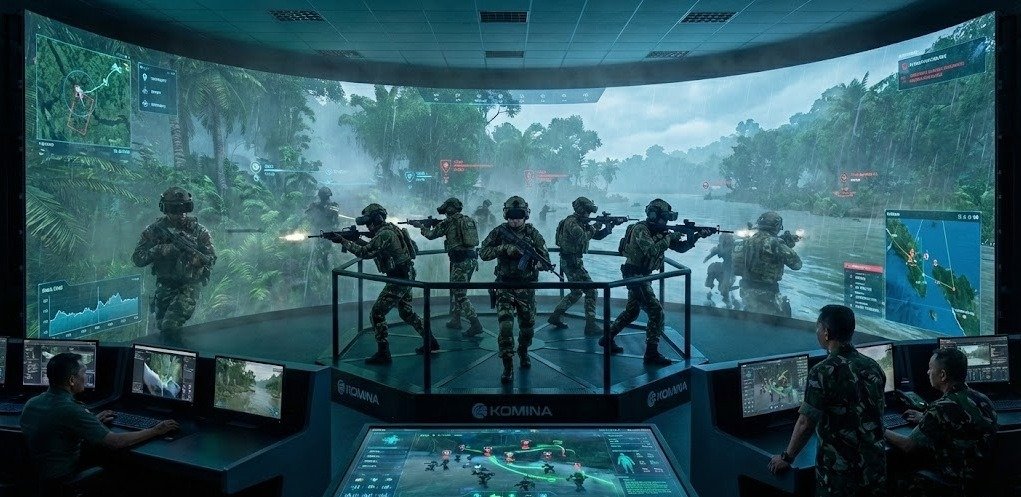
Inside the KOMINA combat simulation training environment, a squad can execute a complex “Urban Warfare” scenario 50 times in a single day with zero marginal cost. They can fail, reset, and try again in seconds.
This high volume of repetition allows soldiers to reach a level of mastery that is mathematically impossible to achieve relying solely on live training with finite budgets. Effectiveness spikes simply because the frequency of training increases drastically.
3. Precision Analytics: Eliminating Subjectivity
“Who shot first?”
“Was the squad formation tight enough?”
In field exercises, evaluation often relies on the limited, biased observation of human instructors. Post-exercise debates consume valuable time.
The KOMINA system records every millisecond of action within the simulation. The After Action Review (AAR) feature provides “black and white” data:
Shot Accuracy: Hit/miss percentages accurate to the decimal.
Reaction Time: Speed of response to sudden threats.
Tactical Positioning: Virtual GPS tracking of personnel movement to evaluate cover and concealment usage.
This objective data allows instructors to dissect unit performance with forensic precision. Specific weaknesses can be identified instantly and corrected on the spot. No assumptions, just raw performance data.
Conclusion: Investing in Lethality
Adopting KOMINA does not mean replacing live training entirely; it means maximizing its value. By using VR to build a rock-solid foundation of competence through high repetition and low cost, your troops will deploy to live field exercises with a significantly higher level of maturity.
This is strategic efficiency. Train more frequently, train smarter, and let the data validate the results.
Contact Us
Are you ready to enhance the performance of your defence team?
Contact us through the email or phone number below:
Email: halo@komina.co
Phone/WhatsApp: +62 812 9696 7887
Address: Jl. Cikunir Raya No. 8, Kota Bekasi,
Jawa Barat 17422, Indonesia.
Website: www.komina.co